NASA's Hubble captures a crimson stellar nursery sparkling with blue and white stars
Hubble has captured a spectacular view of LH 95, where about 2,500 young stars are still on their journey to becoming full-fledged stars. Scientists discovered these growing stars can keep pulling in
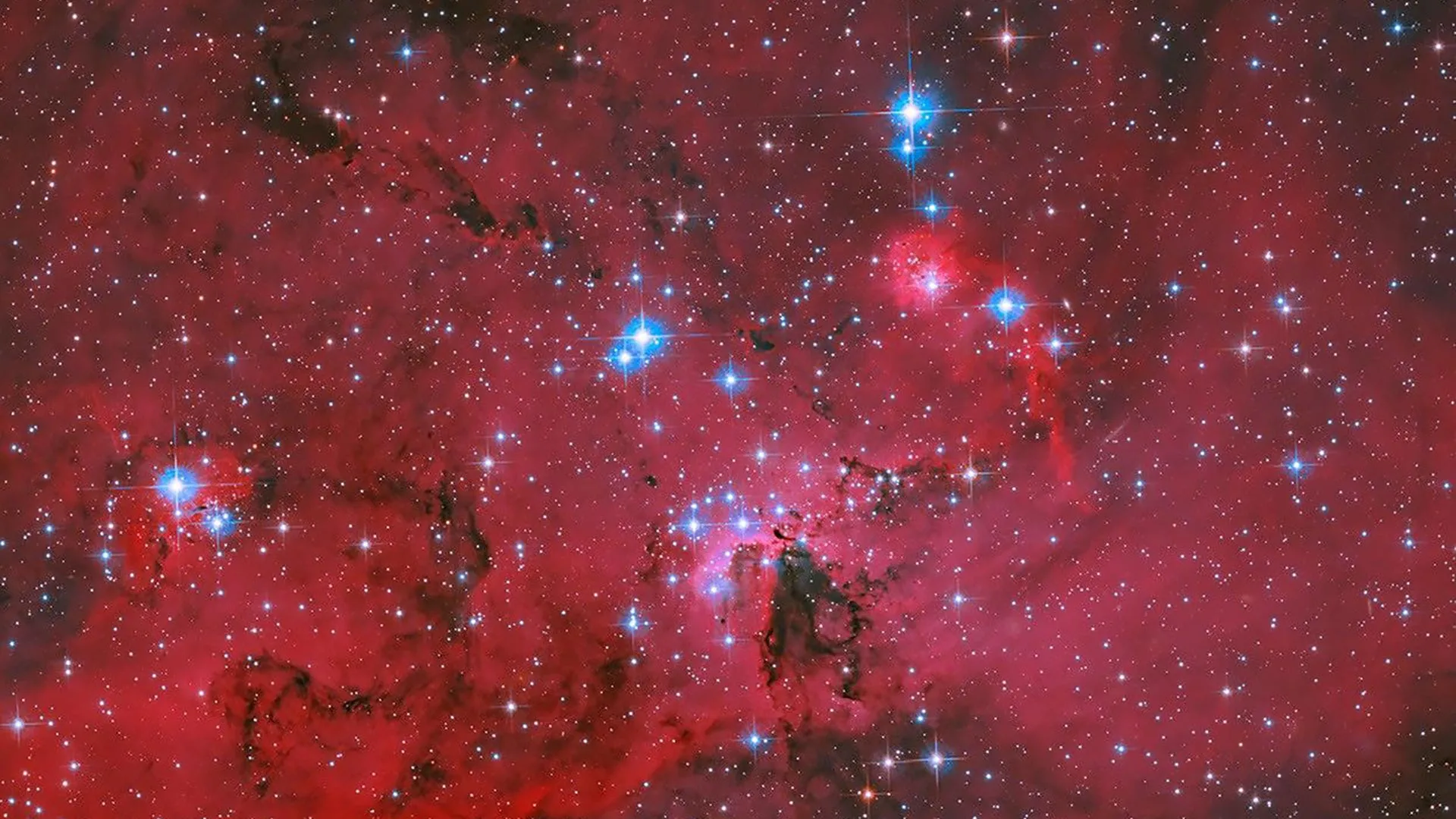
Hubble has captured a spectacular view of LH 95, where about 2,500 young stars are still on their journey to becoming full-fledged stars. Scientists d
Read Full Story at ScienceDaily →Why This Matters
The discovery of LH 95—where a dense cluster of young stars is still in the process of formation—offers a rare glimpse into the chaotic, formative stages of stellar evolution. Such regions challenge our understanding of how massive stars influence their surroundings, reshaping gas clouds and potentially triggering new waves of starbirth. These observations are not just scientific curiosities; they refine models of galaxy formation and evolution, bridging the gap between stellar physics and cosmic structure.
Background Context
Stellar nurseries like LH 95, located in the Large Magellanic Cloud, are among the most dynamic environments in the universe, where gravity, radiation, and stellar winds collide in a delicate balance. Decades of Hubble observations have revealed that these regions are not isolated phenomena but part of a larger, interconnected web of gas and dust stretching across galaxies. The ability to study them in such detail was unimaginable before the Hubble Space Telescope’s launch, which revolutionized astronomy by removing the blurring effects of Earth’s atmosphere.
What Happens Next
Future observations, particularly with the James Webb Space Telescope, will peer deeper into LH 95’s infrared emissions, revealing the hidden processes behind star formation and the role of magnetic fields in shaping these cosmic cradles. Researchers will also look for signs of protoplanetary disks around these young stars, which could hint at the early stages of planetary systems. Meanwhile, astronomers will refine simulations to predict how such clusters evolve over millions of years, testing theories against real-world data.
Bigger Picture
This discovery aligns with a broader trend in astrophysics: the shift from studying individual stars to analyzing entire stellar ecosystems. As instruments like Hubble and Webb push the boundaries of resolution and sensitivity, we’re uncovering how star-forming regions act as cosmic engines, fueling both stellar growth and galactic evolution. Such findings underscore the interplay between local phenomena—like LH 95—and global processes, such as galaxy rotation and dark matter distribution.