Remarkably preserved feathered dinosaur discovered in China reveals new secrets of flying predator evolution
A predatory bird-like dinosaur with four wings discovered in China adds evidence to the idea that flight evolved several times in different dinosaur groups. The exceptionally well-preserved feathere…
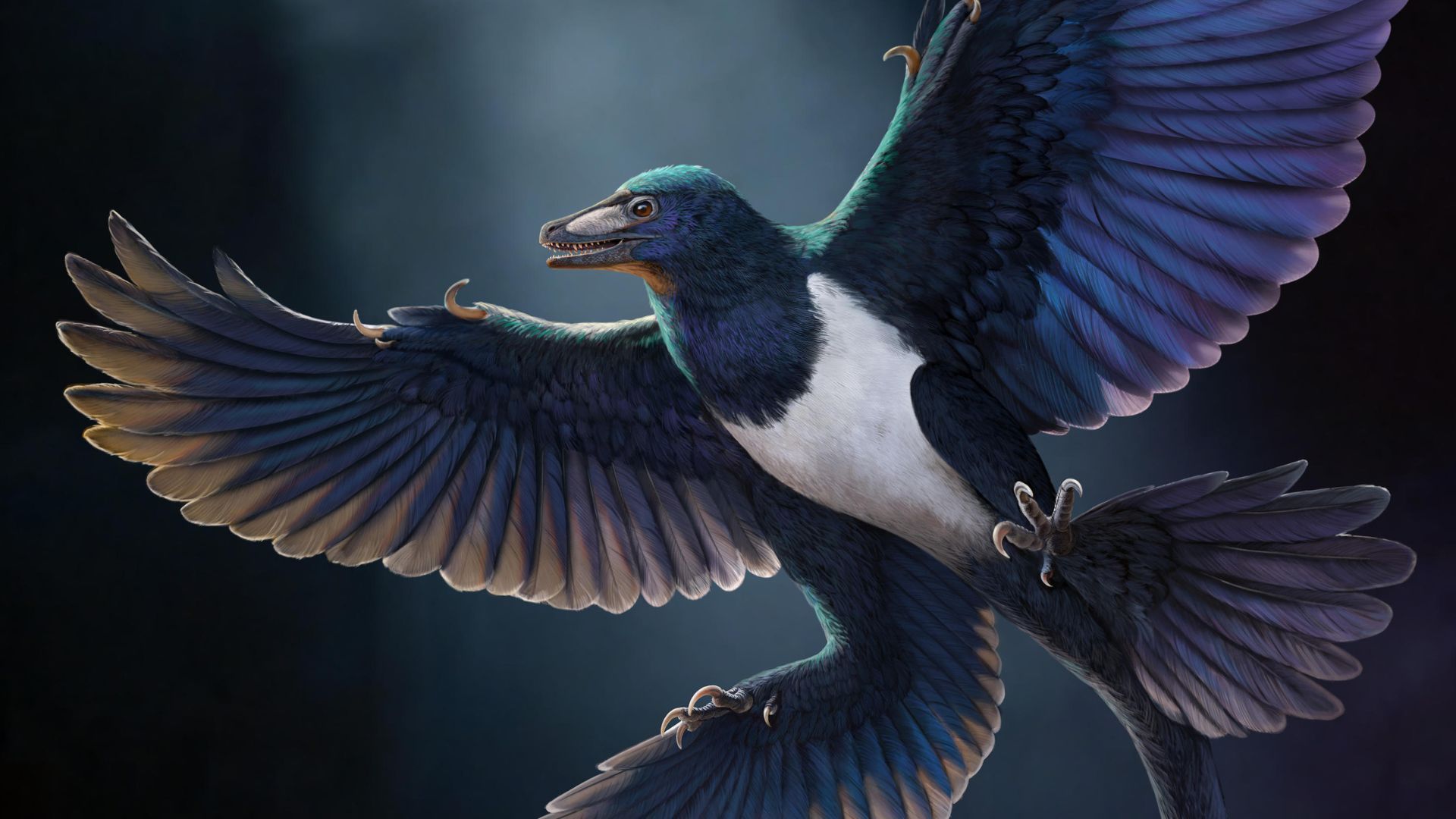
A predatory bird-like dinosaur with four wings discovered in China adds evidence to the idea that flight evolved several times in different dinosaur groups.
The exceptionally well-preserved feathered dinosaur, which has been named Norellraptor barsboldi, was 3 years old when it died and measured just 21 inches (57 centimeters) long. It was found in the Early Cretaceous Jiufotang Formation in northeastern China, which dates to between 145 million and 100 million years ago.
N. barsboldi had the sharply curved predatory teeth and claws you'd expect of a little, generalist predator and was probably eating early mammals , lizards, amphibians and juvenile dinosaurs , said Scott Hartman , a vertebrate paleontologist at the University of Wisconsin-Madison who wasn't involved in the study. "It wouldn't have been attacking any large dinosaurs. That would be like mosquitoes attacking battleships," he told Live Science.
N. barsboldi was a microraptor. Microraptors were close relatives of birds but not their ancestors; birds belong to a neighboring clade called Avialae. Fossils show that both microraptors and early bird-winged animals in the Avialae clade — such as Archaeopteryx , which lived in the Late Jurassic, about 150 million years ago — had feathers. The puzzle has been whether flight originated in an ancestor of both of these groups or if feathers — and potentially flight — evolved more than once.
The description of N. barsboldi by Andrea Cau , a paleontologist at the OPHIS Paleontological Museum and Herpetological Center in Italy, and his colleagues adds evidence to the latter theory. The team's analysis found that around 30% of the 194 anatomical changes identified across microraptor evolution also evolved in the bird lineage. Aside from feathers, these changes included the fusion of bony projections to the ribs that created a rigid torso, forelimb bones that were relatively robust compared with the hind limbs, and an ulna (the primary weight-bearing bone for a wing) that was longer than the humerus.
However, the team's comparisons with other fossils revealed that the order in which these shared features evolved was different in the two groups. They reported the findings Tuesday (Sept. 29) in the journal Nature Communications .
"This demonstrates that microraptors acquired traits convergent with the early evolutionary stages of true birds, albeit through a distinct evolutionary pathway, supporting the hypothesis that flapping flight evolved independently in non-avialan dinosaurs and birds," said Rui Pei , a paleontologist at the Institute of Vertebrate Paleontology and Paleoanthropology at the Chinese Academy of Sciences who wasn't involved in the work.
Get the world’s most fascinating discoveries delivered straight to your inbox.
Read Full Story at Live Science →