Romania's political crisis deepens
The four-party coalition that ruled Romania from summer 2025 until just a few weeks ago was viewed by many as the country's last chance of preventing the far right from coming to power. It was hoped that solid governance an reforms would keep the extremists in check. Yet this st
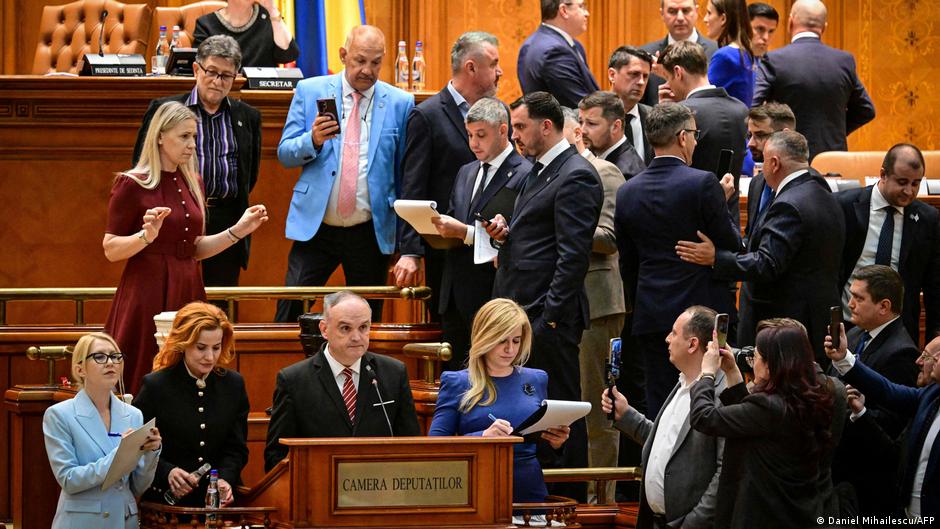
The four-party coalition that ruled Romania from summer 2025 until just a few weeks ago was viewed by many as the country's last chance of preventing the far right from coming to power. It was hoped that solid governance an reforms would keep the extremists in check.
Yet this strategy appears to have failed. Romania's right-wing extremists are riding high in opinion polls, while its moderate parties are bogged down by political squabbling. It's been three weeks since liberal Prime Minister Ilie Bolojan's government collapsed after his own camp launched a vote of no confidence, and none of the country's moderate parties have so far been able to agree who should succeeded him — even though President Nicusor Dan has done his utmost to mediate talks.
But that's not all. While the Bolojan government formally remains in power until it is replaced, Romania's Social Democrats (PSD), who hold most seats in parliament and supposedly support the EU, are increasingly collaborating with the far-right Alliance for the Unification of Romania (AUR). Indeed, political scientist Raluca Alexandrescu says Romania is seeing a "normalization of right-wing extremism."
A massive upheaval could ensue if the pro-Russian, anti-Ukrainian and anti-EU AUR comes to power, or even just plays a supporting role in a Romanian minority government.
After all, Romania is the sixth largest EU country and most important NATO member state in southeastern Europe. It hosts some of the largest and most important NATO bases in the region. Romania has the longest EU border with Ukraine out of all member states and has consistently backed the embattled nation fighting back Russian invaders.
May's no confidence vote, initiated by PSD together with the AUR, was evidence that a dangerous normalization of the far right is ongoing. The PSD, for that matter, was part of Bolojan's coalition.
While there have been previous instances of moderate parties collaborated with right-wing extremists in Romanian parliament, this was the very first time they joined forces to bring down a government. This was the moment the far-right firewall crumbled.
While the PSD has often said it does not aim to form an alliance with the AUR, its actions speak another language. In mid-May, the PSD joined Romania's three far-right parties in supporting a legislative project in parliament's human rights committee to overturn a ban on anti-Semitic, fascist and racist propaganda. The move sparked a public outcry, leading the PSD to backtrack, with party leader Sorin Grindeanu claiming it had been a mere "slip up."