Scientists expected a black hole but found a neutrino factory powered by stars
A distant galaxy nicknamed Shadow Blaster may have revealed a surprising source of cosmic neutrinos: extreme star formation instead of a supermassive black hole. The discovery suggests that hidden, du
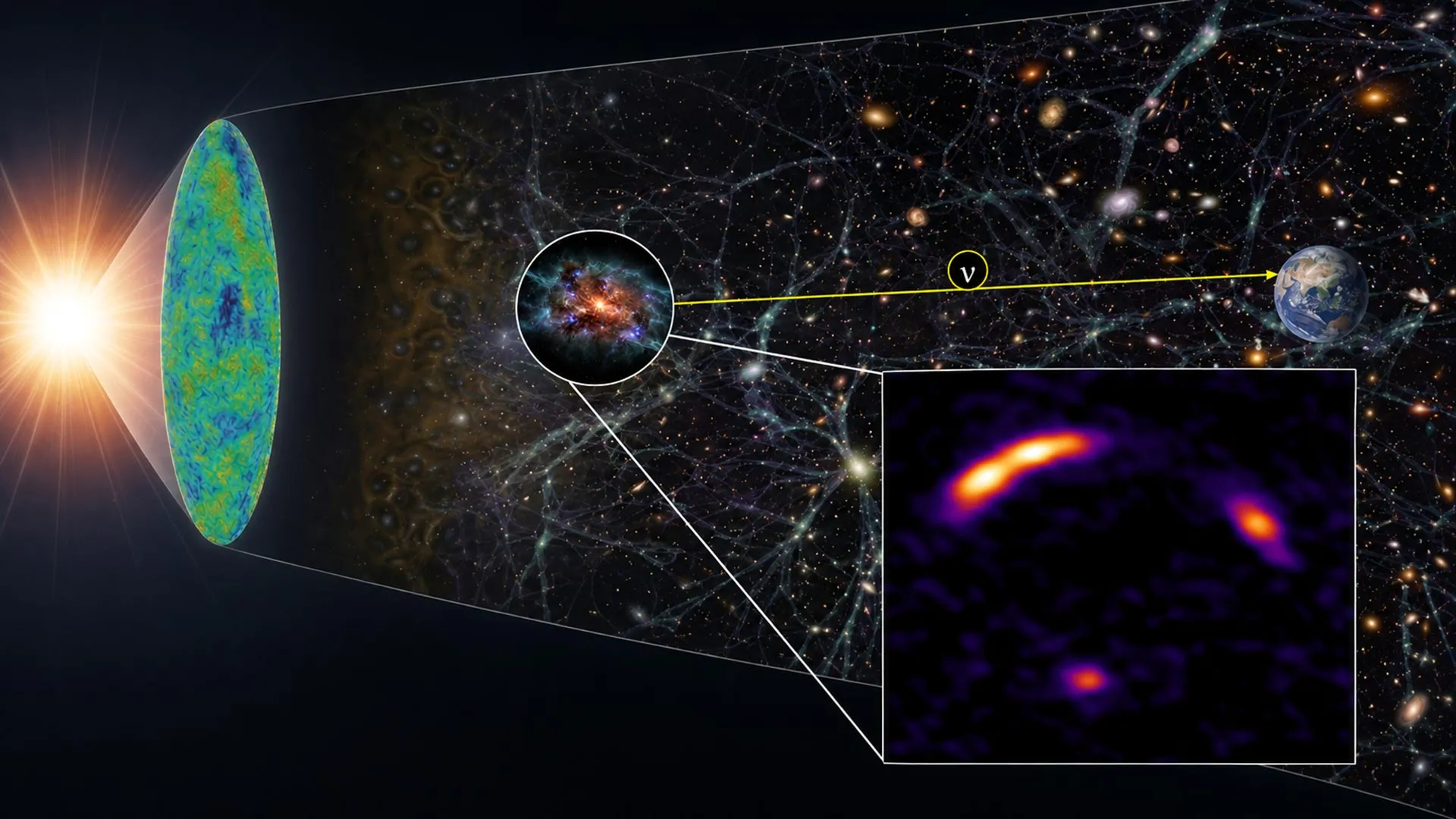
A distant galaxy nicknamed Shadow Blaster may have revealed a surprising source of cosmic neutrinos: extreme star formation instead of a supermassive
Read Full Story at ScienceDaily →The detection of a neutrino factory in the distant galaxy Shadow Blaster challenges long-held assumptions about where some of the universe’s most elusive particles originate. Neutrinos, nearly massless and interacting only via the weak nuclear force, stream through space unperturbed by magnetic fields or matter, making them pristine messengers of extreme cosmic events. For decades, active galactic nuclei—supermassive black holes firing relativistic jets—were the prime suspects as neutrino sources. But the new findings suggest that regions of intense star formation can also generate these particles, potentially reshaping our understanding of cosmic particle accelerators. Galaxies undergoing bursts of star formation, known as starburst galaxies, have long been studied for their prodigious output of radiation and heavy elements. Yet their role in high-energy neutrino production was largely theoretical until now. Shadow Blaster, with its unusually bright and compact core, appears to defy the expected signature of a black hole-dominated system. Instead, the sheer density of young, massive stars and the violent stellar winds they produce may create the conditions for particle acceleration—perhaps in shockwaves from supernovae or colliding stellar winds. If confirmed, this discovery would expand the catalog of astrophysical neutrino sources beyond the presumed black hole paradigm, hinting that the universe’s particle factories are more diverse than previously thought. Open questions remain: What fraction of detected high-energy neutrinos originate from starbursts compared to active galactic nuclei? Could some neutrinos previously attributed to black holes actually come from stellar cataclysms? Future observations with neutrino telescopes like IceCube and next-generation detectors may provide answers by correlating neutrino events with star-forming regions across the sky. This finding also aligns with broader trends in multi-messenger astronomy, where signals from gravitational waves, gamma rays, and neutrinos are combined to map the most violent processes in the cosmos. As instruments improve, surprises like Shadow Blaster may become more common, forcing astrophysicists to reconsider the engines powering the universe’s most energetic phenomena.







