The hunt for extraterrestrial life is fundamentally flawed. But there's a fix.
The hunt for extraterrestrial life on distant planets may be operating with a big blind spot. That's because we aren't accounting for the nature of the light coming from the host star itself when we…
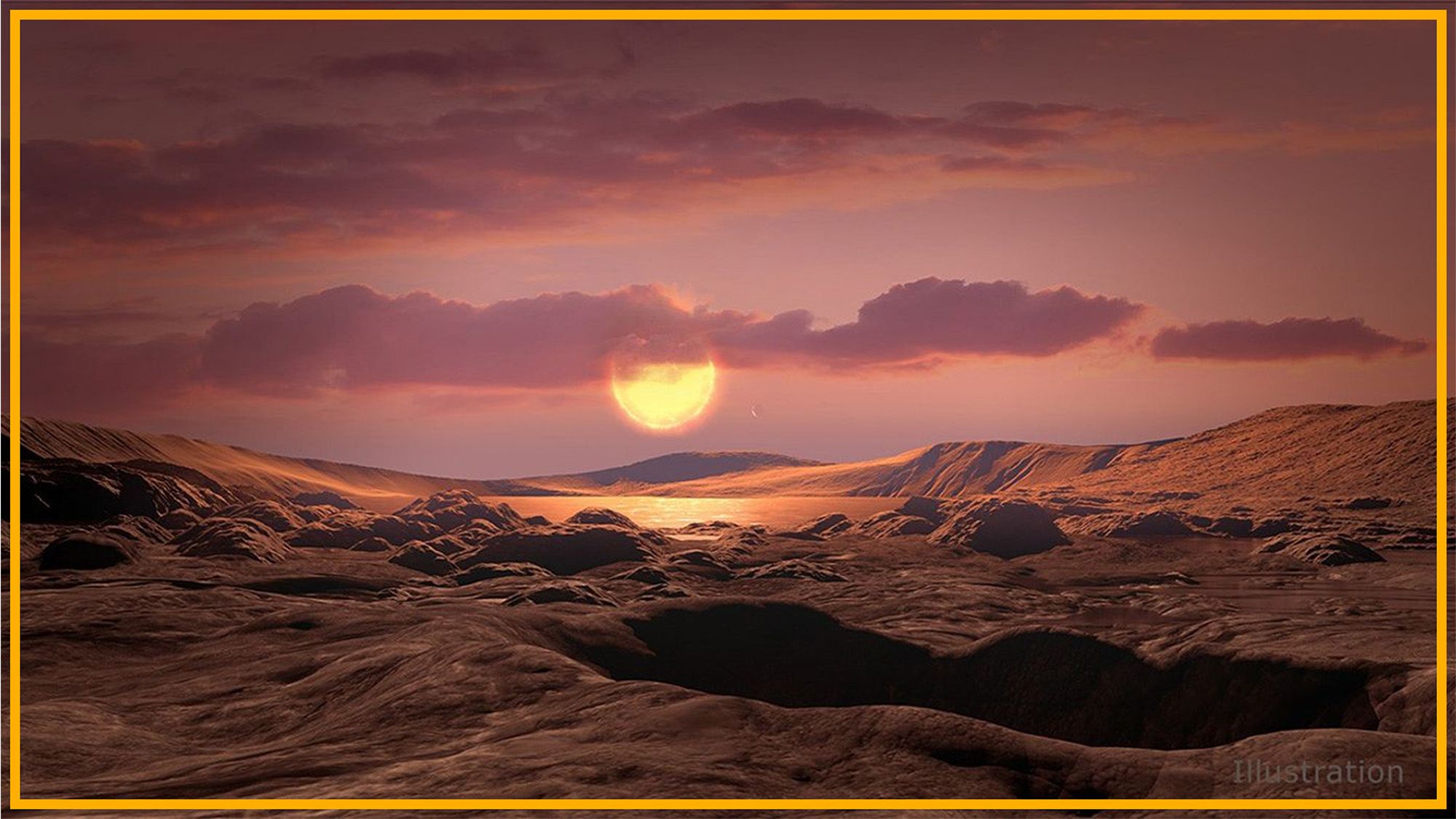
The hunt for extraterrestrial life on distant planets may be operating with a big blind spot.
That's because we aren't accounting for the nature of the light coming from the host star itself when we interpret the chemical signatures of life, or biosignatures, on some of the most promising candidate planets beyond the solar system . If we don't consider that crucial factor, we could be led on a wild-goose chase across the cosmos.
Despite having discovered thousands of exoplanets , we have not detected convincing evidence of alien life on any of them. But astronomy is reaching a point where powerful telescopes can zoom in on many more potentially habitable worlds. Planets that orbit M dwarfs, which are small stars cooler than the sun, are particularly promising targets because they have a unique observation window. When a planet passes in front of one of these stars, it blocks a relatively large fraction of the star's light, making the planet and its atmosphere easier to detect.
Dr Alix Violet Freckelton is an exoplanetary and stellar astrophysicist at the University of Birmingham in England. Her research uses high-resolution spectroscopy to characterize stars and planetary systems, with particular expertise in how uncertainties in host stars affect what astronomers learn about their planets. She has analyzed over 2,000 stars and developed automated tools for measuring their properties. Her work spans stellar activity, radial velocity studies, and the characterisation of stars hosting exoplanets. Alongside her academic research, she has a passion for engaging with the public about exoplanets, observational science, and the search for life beyond Earth.
There are also a lot of them. M dwarfs are the most common type of star in the Milky Way . However, if we misunderstand how these stars interact with planetary atmospheres, we may misinterpret the significance of observations from some of the most promising planets.
The most-studied biosignatures are methane, oxygen and ozone. On Earth, these are often produced by biological processes, with ozone acting as an indirect indicator of oxygen. But even on our home planet, molecules typically associated with life are not unambiguous biological fingerprints . These molecules can be produced by geological and chemical processes, as well as via atmospheric reactions with light from the sun.
A potential biosignature detection found elsewhere in the cosmos is therefore a clue, not proof of life. We can't interpret the chemical signals coming from a potentially habitable planet without understanding the star that illuminates it. M dwarfs produce ultraviolet radiation that can break apart molecules and trigger chemical reactions in the atmosphere of an orbiting planet. The intensity and wavelength of the radiation influence which molecules form and survive, as well as how abundant they become. Two planets with otherwise identical properties could develop very different atmospheres simply because they orbit stars with different ultraviolet emissions. Radiation from a star could therefore make the same level of biological activity appear stronger on one planet than on another, or make nonbiological chemistry look like life. A recent study submitted to the preprint server arXiv Aug. 19 demonstrated this using entirely simulated planets. The researchers, led by University of California, Santa Cruz astronomy graduate student C. Evan Davis, simulated Earth-like planets orbiting two different types of M dwarf with ages ranging from 650 million to 5 billion years.
The team considered atmospheres resembling that of Earth during the oxygen-rich preindustrial era and the Archean eon (about 4 billion to 2.5 billion years ago), during which the first life-forms emerged but atmospheric oxygen was scarce. The models considered the stars' usual, or "quiescent," ultraviolet emission rather than short-lived flares. By changing the modeled stars' ages and ultraviolet radiation while keeping the planets comparable, they investigated how a star's evolution changed an atmosphere and the signals astronomers might observe.
Read Full Story at Live Science →