This star has the strangest sky in the galaxy
The newfound star S301 orbits the Milky Way’s supermassive black hole so closely that its view of the heavens gets twisted Stay connected to The Universe: Get email alerts for this weekly column by …
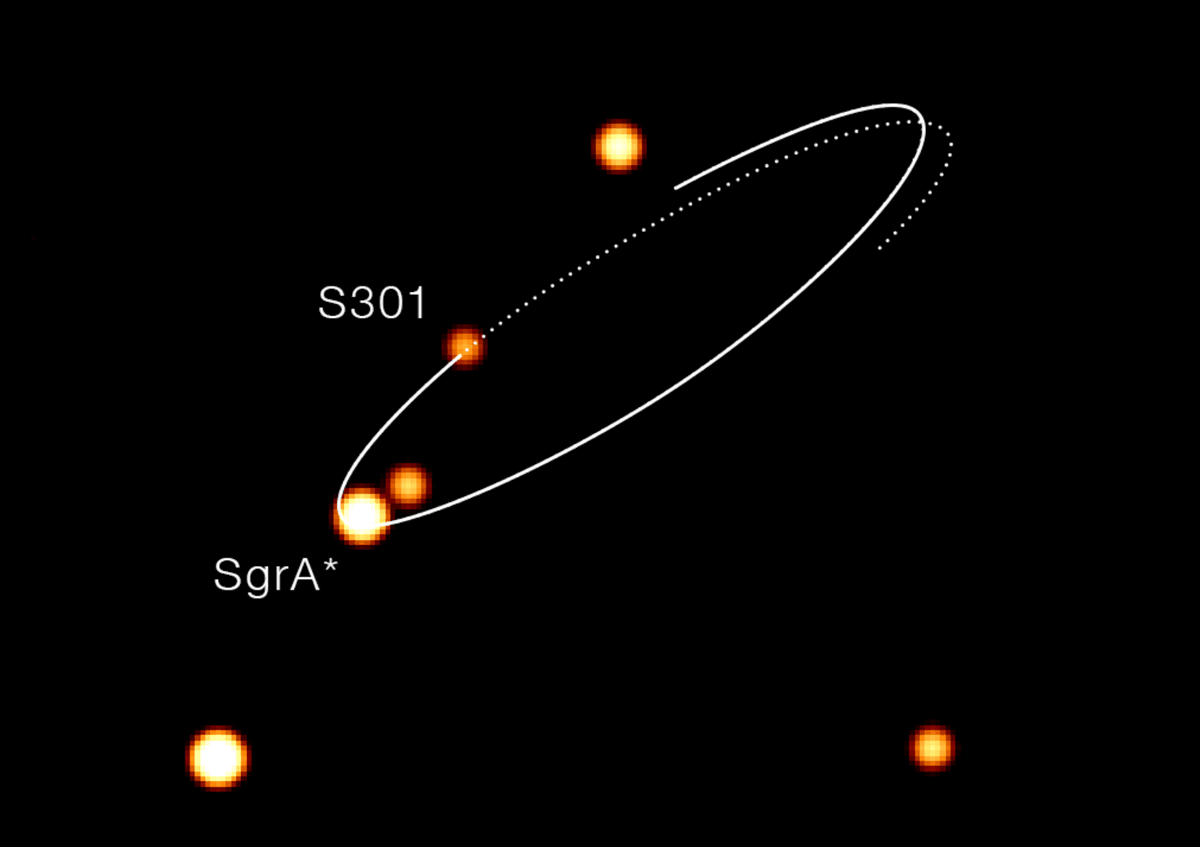
The newfound star S301 orbits the Milky Way’s supermassive black hole so closely that its view of the heavens gets twisted
Stay connected to The Universe: Get email alerts for this weekly column by Phil Plait
There are a lot of weird stars in the universe, but if I had to pick the very weirdest, it would be S301.
The name is prosaic, but it hides profundity. Ironically the star itself isn’t really peculiar at all. It’s much like the sun, though somewhat more massive, hotter and more luminous. There are billions more just like it in the galaxy at large.
If this star was almost anywhere else in the universe, it would be downright mundane. But as any cosmic real estate agent will tell you, it’s all about location, location, location. It’s not the star; it’s the neighborhood.
If you're enjoying this article, consider supporting our award-winning journalism by subscribing . By purchasing a subscription you are helping to ensure the future of impactful stories about the discoveries and ideas shaping our world today.
S301, you see, orbits Sagittarius A* (Sgr A*), the supermassive black hole that inhabits the exact geometric center of our Milky Way galaxy . And from there, its view of the cosmos is odd— more than odd, really, because the star experiences severely warped time and space.
At 4.3 million times the sun’s mass, Sgr A* dominates the region. Its gravity is extremely strong, of course, holding sway over a menagerie of objects around it. This includes a swarm of stars called the S-star cluster. Dozens of very luminous stellar cluster members are known, but this area likely has far more stars that are fainter hidden behind a vast smog of opaque dust between the center of the galaxy and the sun .
Read Full Story at Scientific American →