Webb snaps warped galaxy images to map dark matter
NASA’s Webb telescope imaged the MACS J0454.1-0300 cluster, using gravitational lensing to reveal multiple warped galaxy images. This data allows scientists to map dark matter distribution and test c…
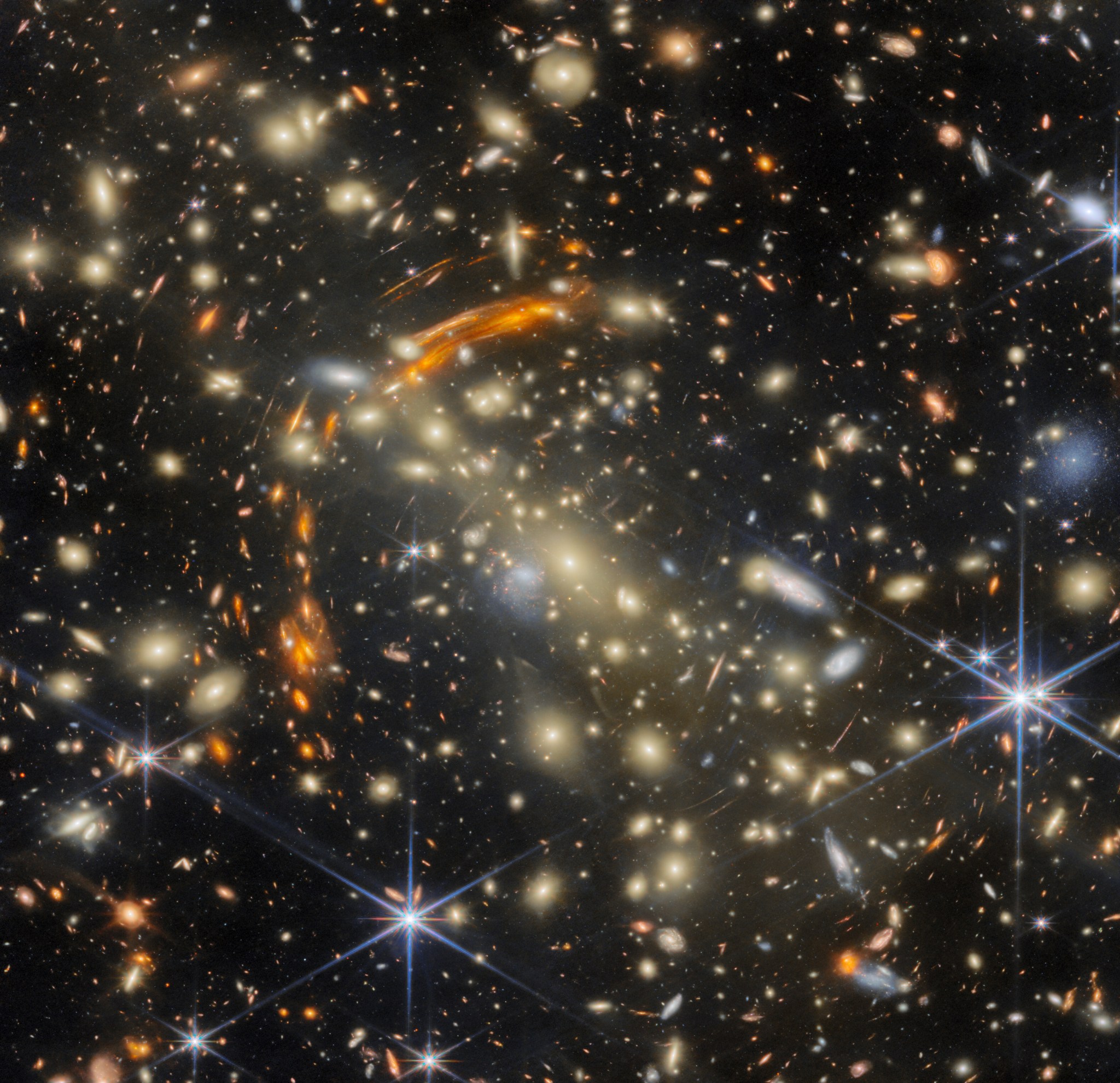
NASA’s James Webb Space Telescope released a striking new image on Sept. 29 2026 that shows galaxies warping and multiplying like a house of mirrors. The bright golden shapes are distant galaxies in the cluster MACS J0454.1‑0300, located about 4.5 billion light‑years from Earth. The orange blobs on one side of the frame are not part of the cluster; they are foreground galaxies whose light is also bent by the cluster’s gravity.
Gravitational lensing is the key to this view. The cluster’s immense mass, mostly dark matter, acts like a giant lens, bending light from galaxies behind it. The effect creates multiple, magnified images of the same galaxy, stretching them into arcs and rings. This phenomenon lets astronomers map the cluster’s mass distribution and study the universe’s expansion and structure at a time when galaxies were still forming.
The image contains more than a dozen multiply‑imaged galaxies. Webb’s sharp optics reveal faint, distant galaxies that would otherwise be invisible. Scientists estimate the cluster’s mass at roughly 10^15 solar masses, enough to bend light from galaxies several times over. By comparing the positions of the lensed images with models, researchers can infer the shape of the dark matter halo and test theories about its particle nature. The orange galaxies, being closer, provide a baseline for calibrating the lensing models.
NASA plans to use the data to refine its dark‑matter maps and to search for subtle deviations that could hint at new physics. The Webb team will publish detailed mass models in the coming months and will target additional massive clusters in the next observing cycle. The public will gain access to the raw images and the analysis tools, allowing independent research. This work will deepen our understanding of how gravity shapes the cosmos and may help unlock the mystery of dark matter, a major goal of modern astronomy.
Read Full Story at NASA →