Debt Payoff Calculator (Snowball vs Avalanche)
Compare the snowball and avalanche methods to pay off multiple debts · free, no signup
See Debt Payoff Calculator (Snowball vs Avalanche) in action
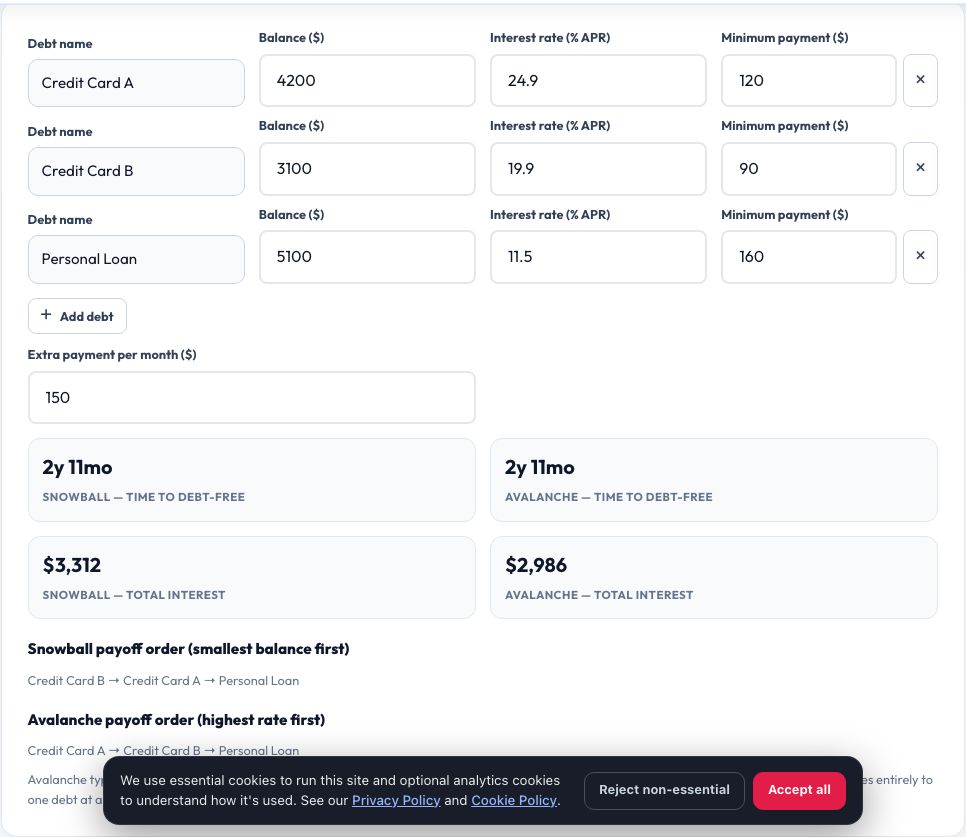
Free Debt Payoff Calculator — Snowball vs Avalanche
Paying off several debts at once — credit cards, a car loan, a personal loan — raises an obvious question: which one should extra money go toward first? Add each debt's balance, interest rate and minimum payment, plus any extra amount you can put toward debt each month, and this calculator builds a full payoff schedule using two popular strategies.
The debt snowball pays off the smallest balance first for quick psychological wins, while the debt avalanche pays off the highest interest rate first to minimise total interest paid. The calculator shows the payoff order, months to debt-free and total interest paid for each method side by side, so you can choose the approach that fits how you stay motivated.
Key features
Unlimited debts
Add every credit card and loan you are tracking.
Two strategies compared
Snowball (smallest balance first) and avalanche (highest rate first).
Full payoff schedule
Order, months to debt-free and total interest for each method.
Extra payment modelling
See how adding even a small extra amount speeds up payoff.
How to use it
- Add each debt's balance, interest rate and minimum payment.
- Enter any extra amount you can pay each month.
- Compare the snowball and avalanche schedules.
- Follow the payoff order shown for your chosen method.
Worked example
Example
3 debts totalling $12,400 with $150 extra a month → avalanche method: debt-free in 22 months, $1,340 total interest, versus snowball: debt-free in 23 months, $1,510 total interest.
Who uses this tool
Anyone with more than one debt
Decide the smartest order to pay debts off.
Budget planners
See exactly how extra monthly payments shorten the timeline.
People motivated by quick wins
Use the snowball method's early payoffs to build momentum.
Tips for the best results
- Always pay at least the minimum on every debt to avoid fees and credit damage.
- The avalanche method saves the most money in interest; the snowball method often keeps people more motivated to continue.
- Put any windfall (tax refund, bonus) toward the next debt in your chosen order.
- Stop adding new debt to the cards you are paying off, or the payoff plan resets.
Common mistakes to avoid
- Only paying minimums, which can take years and add significant interest.
- Splitting extra payments evenly across every debt instead of focusing on one at a time.
- Ignoring a high interest rate because the balance feels small.
Why use AZRS QuickFix?
It is 100% free, needs no signup and has no watermark or usage limits. The tool runs in your browser, so what you type stays on your device, and it works on phones, tablets and desktops. New tools are added every week — bookmark this page or browse the full QuickFix toolbox.
Frequently asked questions
What is the difference between snowball and avalanche?
Snowball pays the smallest balance first for quick wins; avalanche pays the highest interest rate first to save the most money overall.
Which method is better?
Avalanche minimises total interest paid; snowball can be more motivating because debts disappear faster — either works if you stick to it.
Does adding extra payments really make a big difference?
Yes, even a modest extra amount each month can cut months or years off a payoff timeline and save significant interest.
Should I pay off debt or invest first?
It depends on the interest rate versus expected investment return; high-interest debt (like most credit cards) is usually paid off first.
Is my financial data stored?
No, it is calculated locally in your browser and never uploaded.
Can I include a mortgage?
You can, though many people exclude a low-rate mortgage from a debt-payoff plan and focus on higher-interest debts first.