Resistor Color Code Calculator
Decode a resistor's colour bands into its resistance value, or encode a value into bands · free, no signup
See Resistor Color Code Calculator in action
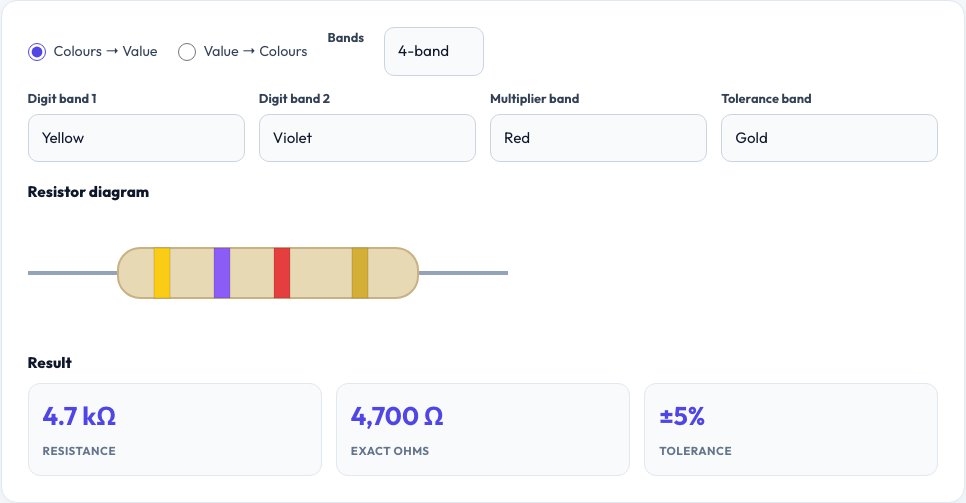
Free Resistor Color Code Calculator
Reading a resistor's coloured bands correctly requires memorising the colour-to-digit code and knowing which band is the multiplier versus the tolerance, which is easy to get backwards under a magnifying glass or bad lighting. This calculator works in both directions: pick the colour of each band on a standard 4-band or 5-band resistor and it instantly shows the resistance value, tolerance and typical use case, or type in a resistance value and it shows you which colour bands to expect.
It follows the standard IEC 60062 colour code used on virtually all through-hole resistors, and the visual resistor diagram updates live as you pick colours, so you can directly compare it against the physical component in your hand to confirm you're reading it correctly.
Key features
4-band and 5-band support
Covers the two most common resistor band layouts.
Works both directions
Decode colours to a value, or encode a value to colours.
Live visual diagram
A resistor graphic updates as you pick each band's colour.
Includes tolerance
Shows the ± tolerance percentage alongside the resistance.
How to use it
- Choose 4-band or 5-band.
- Select each band's colour from the dropdowns, in order.
- Read the calculated resistance and tolerance.
- Or switch to Value → Colours and type a resistance to see the matching bands.
Worked example
Example
4-band: Yellow, Violet, Red, Gold → 47 × 100 = 4,700 Ω (4.7 kΩ), ±5% tolerance.
Who uses this tool
Electronics hobbyists
Quickly identify an unmarked or hard-to-read resistor.
Students learning electronics
Practise and check resistor colour code readings.
Makers and repair technicians
Confirm a replacement resistor matches the value needed.
Tips for the best results
- Read bands starting from the end furthest from the tolerance band, which is usually gold or silver and slightly separated from the others.
- Use good, even lighting or a loupe for brown/red/orange distinctions, which are commonly confused.
- Double-check with a multimeter when precision matters — colour reading has room for human error even when done carefully.
- 5-band resistors have an extra digit band for tighter tolerance components; don't mistake them for a 4-band reading.
Common mistakes to avoid
- Reading the tolerance band as a value band, throwing off every digit that follows.
- Confusing brown, red and orange in poor lighting — they're a common source of misreads.
- Mixing up 4-band and 5-band layouts, which changes which band is the multiplier.
Why use AZRS QuickFix?
It is 100% free, needs no signup and has no watermark or usage limits. The tool runs in your browser, so what you type stays on your device, and it works on phones, tablets and desktops. New tools are added every week — bookmark this page or browse the full QuickFix toolbox.
Frequently asked questions
How do I know if my resistor is 4-band or 5-band?
Count the coloured bands: 4-band resistors have two digit bands, a multiplier and a tolerance band; 5-band resistors have three digit bands, a multiplier and a tolerance band, typically for tighter-tolerance components.
Which end do I start reading from?
Start from the band closest to one edge, furthest from the tolerance band — the tolerance band (often gold or silver) is usually spaced slightly apart from the rest and comes last.
What does the gold or silver band mean?
It indicates the tolerance: gold is typically ±5% and silver ±10%, meaning the actual resistance may vary from the stated value by that percentage.
Can I look up colours for a specific resistance value?
Yes, switch to Value → Colours mode, type the resistance, and it shows the matching band colours.
Does this work for surface-mount (SMD) resistors?
No, SMD resistors typically use printed numeric codes rather than colour bands; this tool covers only colour-banded through-hole resistors.
Is the colour code standardised?
Yes, it follows the IEC 60062 standard used industry-wide for colour-banded resistors.