Sleep Debt Calculator — Real Nights Owed
Real arithmetic on how many full nights of sleep you're behind on · free, no signup
See Sleep Debt Calculator — Real Nights Owed in action
Sleep Debt Calculator
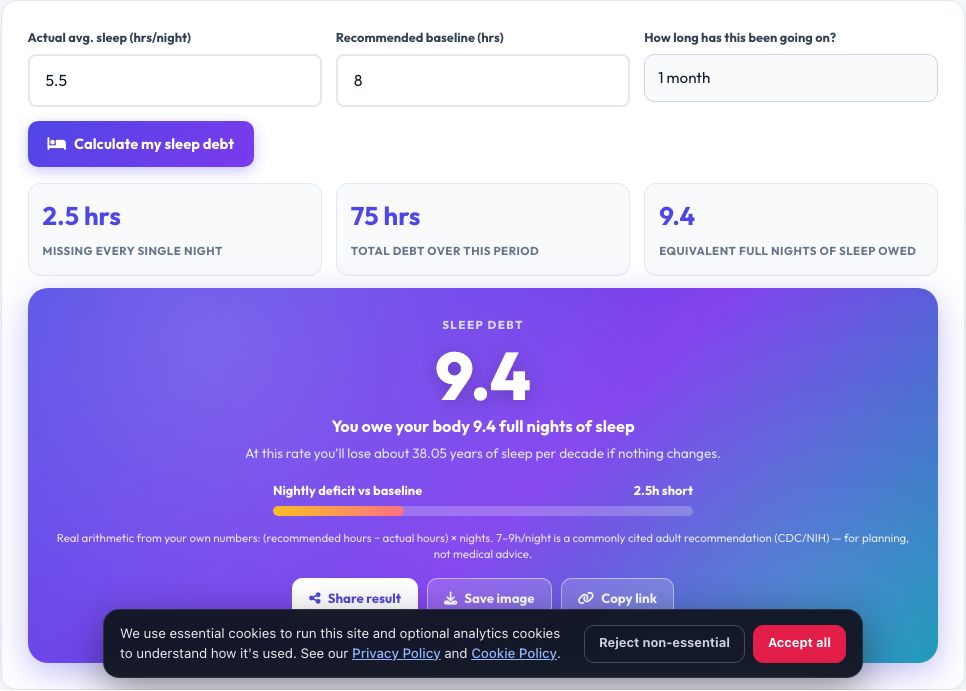
Enter your actual average nightly sleep, a recommended baseline (commonly 7–9 hours for adults per the CDC and NIH), and a time span, and this tool multiplies the nightly deficit by the number of nights to show your total sleep debt in hours and in equivalent full nights owed.
It also projects, at your current deficit rate, roughly how many years of sleep you'd lose per decade if nothing changes — real arithmetic, not a scare number.
Key features
Real, auditable arithmetic
Nightly deficit × nights, shown plainly.
Multiple time spans
See debt over a week, month, year or five years.
Full-nights-owed conversion
Turns hours into an intuitive 'nights owed' figure.
Long-run projection
See the yearly impact if the habit continues.
How to use it
- Enter your actual average nightly sleep.
- Enter your recommended baseline (7–9h is typical for adults).
- Pick a time span.
- See your total sleep debt and nights owed.
Worked example
Example
5.5h actual vs an 8h baseline over 1 month → about 75 hours of debt, roughly 9.4 full nights owed.
Who uses this tool
Anyone tracking their sleep
A concrete, motivating debt figure.
Shift workers and new parents
See the real cumulative cost of short nights.
Health and wellness creators
A shareable, honestly calculated stat.
Tips for the best results
- Use your real average, not your best night, for an accurate figure.
- Recalculate monthly to track whether the debt is growing or shrinking.
- This is a planning aid, not a medical measurement — consult a professional for real sleep concerns.
Common mistakes to avoid
- Using an unrealistically high baseline that inflates the debt.
- Treating this as a medical diagnosis rather than a simple math tool.
Why use AZRS QuickFix?
It is 100% free, needs no signup and has no watermark or usage limits. The tool runs in your browser, so what you type stays on your device, and it works on phones, tablets and desktops. New tools are added every week — bookmark this page or browse the full QuickFix toolbox.
Frequently asked questions
What baseline should I use?
7–9 hours per night is a commonly cited recommended range for adults from health bodies like the CDC and NIH; pick a specific number within that range.
Is this a medical measurement?
No, it's a straightforward arithmetic tool for planning, not a medical or clinical sleep assessment.
Can my debt be zero?
Yes, if your actual sleep meets or exceeds your baseline every night in the period.
Does naps count?
Only if you include them in your entered nightly average — the tool just uses whatever number you provide.
Is my data stored?
No, everything is calculated locally in your browser.
Can I share my sleep debt?
Yes, using the Share or Save image buttons on the result card.