Unit Price Comparator (Cost Per Weight/Volume/Item)
Compare grocery and shopping prices by weight, volume or item to find the real best value · free, no signup
See Unit Price Comparator (Cost Per Weight/Volume/Item) in action
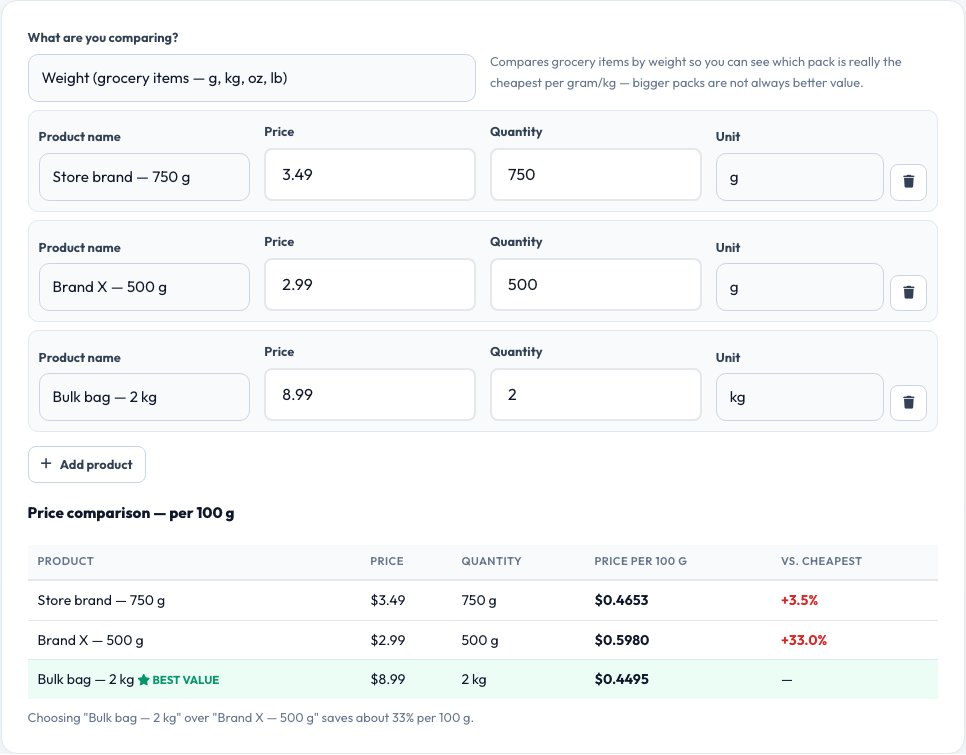
Unit Price Comparator — Find the Real Cheapest Option
Stores rarely make it easy to compare a 750 g bag against a 2 kg bag, or a 500 ml bottle against a 1 L bottle, at a glance — and the bigger pack is not automatically the better deal. This comparator lets you enter the price, quantity and unit (grams, kilograms, ounces, pounds for weight; millilitres, litres, fluid ounces, gallons for volume; or a simple item count for multi-packs) for two or more products, converts everything to a common base, and ranks every option by its true price per 100 g, per 100 ml or per item.
The result table highlights the best-value option and shows exactly how much more every other option costs as a percentage, so you can see at a glance whether the family-size pack, the store brand or the multi-buy deal is really saving you money. Everything is calculated instantly in your browser as you type — add as many products as you like and switch between weight, volume and count categories for different kinds of shopping comparisons.
Key features
Weight, volume or count
Compares grams/kg/oz/lb, ml/L/fl oz/gal, or item packs.
Any number of products
Add as many options as you are comparing.
Instant best-value ranking
Highlights the cheapest option and the % premium on the rest.
No sign-up, fully private
Runs in your browser; nothing is sent anywhere.
How to use it
- Choose whether you are comparing by weight, volume or item count.
- Enter each product's name, price, quantity and unit.
- Add more products with the + button if you have more than two.
- Read the price-per-unit column — the highlighted row is the best value.
Worked example
Example
750 g bag at $3.49 = $0.47/100g. A 2 kg bulk bag at $8.99 = $0.45/100g — the bulk bag is about 4% cheaper per gram even though it costs more upfront.
Who uses this tool
Grocery shoppers
Settle which pack size is genuinely cheaper before buying.
Bulk buyers and families
Check whether a larger multi-pack really saves money.
Budget-conscious shoppers
Compare store brands against name brands fairly.
Tips for the best results
- Always compare using the same base unit — this tool converts for you automatically.
- Watch for "per item" deals (like toilet roll multi-packs) where sheet count or size can differ between packs.
- Sale prices and loyalty-card prices change fast — re-check at the till if the difference is large.
- For recipes and bulk cooking, per-100g pricing usually matters more than the sticker price.
Common mistakes to avoid
- Assuming the larger package is always cheaper per unit — it sometimes costs more.
- Comparing a price per item against a price per weight without converting first.
- Forgetting that unit price on the shelf label sometimes uses a different base (per 100g vs per kg) than the one you are mentally comparing.
Why use AZRS QuickFix?
It is 100% free, needs no signup and has no watermark or usage limits. The tool runs in your browser, so what you type stays on your device, and it works on phones, tablets and desktops. New tools are added every week — bookmark this page or browse the full QuickFix toolbox.
Frequently asked questions
Does this account for quality differences?
No — it only compares price per unit of quantity. Two products at the same unit price can still differ in quality or ingredients.
Can I compare items in different currencies?
Enter the numeric price only; the comparison works in any currency as long as every product uses the same one.
What if a product size is given per item, like eggs or diapers?
Choose the Count category and enter the item quantity (e.g. 12) — the tool then compares price per item.
Why do you convert oz and lb to grams?
So that products measured in imperial and metric units can be compared fairly on the same scale.
Is my shopping list stored anywhere?
No. Everything you enter stays in your browser and disappears when you leave the page.
Can I use this for non-grocery items?
Yes — it works for anything sold by weight, volume or item count, such as cleaning supplies, pet food or craft materials.