Overthinking Score — Rumination Self-Check
A short self-report quiz based on real rumination-scale concepts, with a percentile score · free, no signup
See Overthinking Score — Rumination Self-Check in action
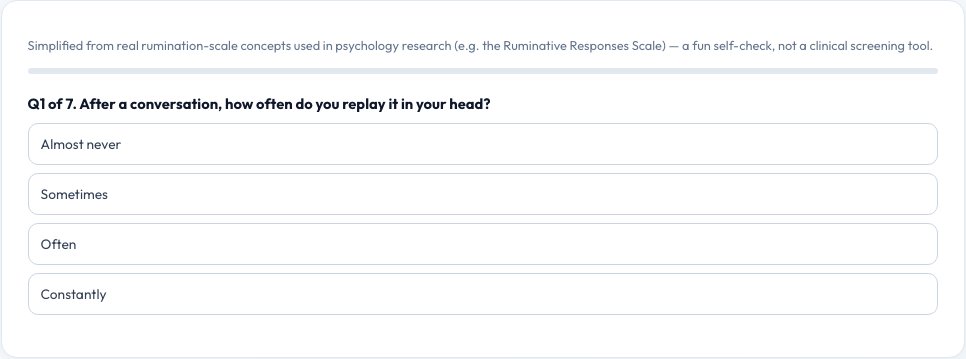
Overthinking Score
Seven quick questions ask how often you replay conversations, get stuck comparing decisions, or dwell on small mistakes — simplified from real concepts used in psychological rumination research, such as the Ruminative Responses Scale, scaled down to a fast, shareable format.
Your raw score is mapped to a percentile using a stated normal-distribution model calibrated to typical self-report rumination-scale score distributions (which tend to cluster near the middle with a real tail of high scorers), and shown with a funny tiered label.
Key features
Based on real rumination-scale concepts
Simplified from published self-report scale ideas, not invented from scratch.
7 quick questions
Fast multiple-choice, no typing.
Percentile estimate
Modeled, not a fabricated live-data number.
Clearly framed as non-clinical
A self-check for fun, not a diagnosis.
How to use it
- Answer all 7 questions about rumination habits.
- See your raw score and estimated percentile.
- Read your funny tiered label and share the result.
Worked example
Example
Frequently replaying conversations, rehearsing them in advance, and losing sleep to racing thoughts produces a high Overthinking Score and a top-percentile estimate.
Who uses this tool
Anyone curious about their overthinking habits
A fast, honest self-check.
Mental-wellness content creators
A shareable, non-clinical self-report tool.
Friend groups
Compare scores and laugh about shared habits.
Tips for the best results
- Answer based on your typical pattern, not just a recent stressful week.
- Use a high score as a prompt to look into real rumination-reduction techniques or talk to a professional if it's affecting your life.
- Retake it periodically to notice trends.
Common mistakes to avoid
- Treating this as a clinical diagnosis of anxiety or OCD — it is explicitly not that.
- Answering based on a single unusually stressful day rather than your general pattern.
Why use AZRS QuickFix?
It is 100% free, needs no signup and has no watermark or usage limits. The tool runs in your browser, so what you type stays on your device, and it works on phones, tablets and desktops. New tools are added every week — bookmark this page or browse the full QuickFix toolbox.
Frequently asked questions
Is this a clinical or diagnostic tool?
No, it's simplified from real rumination-scale concepts for a fast, shareable self-check, not a clinical or diagnostic assessment.
What is a rumination scale?
A type of psychological self-report questionnaire (such as the Ruminative Responses Scale) that measures how often someone dwells on negative thoughts or past events.
How is the percentile calculated?
Your raw score is mapped to a percentile using a normal-distribution model calibrated to typical self-report rumination-scale score patterns, not live data from other users.
Should I see a professional if I score high?
If rumination is significantly affecting your daily life or wellbeing, consider speaking with a mental health professional; this tool isn't a substitute for that.
Is my data stored?
No, everything runs locally in your browser.
Can I share my score?
Yes, using the Share or Save image buttons on the result card.