Credit Card Number Validator (Luhn Test)
Check whether a card number passes the real Luhn checksum used by card networks, or generate test numbers · free, no signup
How Credit Card Number Validator (Luhn Test) works, step by step
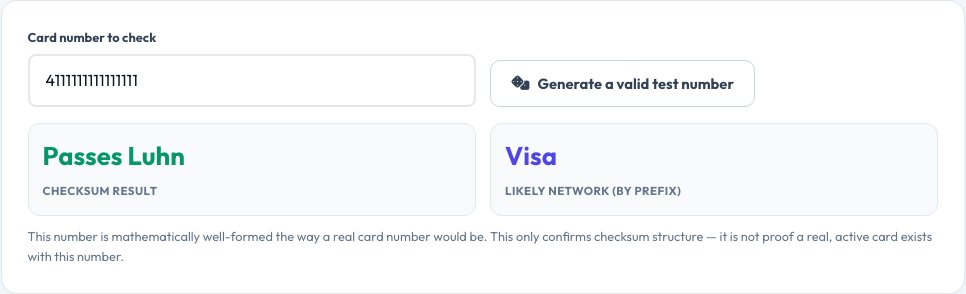
Paste a card number to check, or click Generate to create a valid test number.
 Download it
See whether it passes the Luhn checksum.
Credit Card Number Validator — Luhn Checksum Test
The Luhn algorithm is the checksum formula card networks (Visa, Mastercard, American Express, Discover and others) build into every card number, so that a single mistyped or transposed digit can be caught instantly without contacting a bank. Paste any card-shaped number and this tool runs the real Luhn calculation — doubling every second digit from the right, summing the digits, and checking the total is divisible by 10 — to tell you whether it's mathematically valid, and identifies the likely network from its starting digits and length.
It's important to be clear about what this checks and doesn't: passing the Luhn test only proves the number is mathematically well-formed the way a real card number would be — it says absolutely nothing about whether the card exists, is active, or belongs to anyone. This tool also generates properly Luhn-valid test numbers on demand, useful for developers testing checkout forms, since using a real card number for testing is unnecessary and risky.
Key features
Real Luhn checksum, not a format guess
Runs the actual mod-10 algorithm used by every major card network.
Card network identification
Detects the likely network (Visa, Mastercard, Amex, Discover, etc.) from prefix and length patterns.
Test number generator
Creates properly Luhn-valid fake numbers for safely testing payment forms.
Clearly not a fraud or verification tool
Honest about only checking mathematical structure, never real-world validity.
How to use it
- Paste a card number to check, or click Generate to create a valid test number.
- See whether it passes the Luhn checksum.
- See the likely card network based on its prefix and length.
- Use generated test numbers only in sandbox/test payment environments, never claimed as real.
Worked example
Example
4111 1111 1111 1111 -> passes the Luhn check and matches Visa's prefix pattern — this is itself a widely published, standard test number, not a real account.
Who uses this tool
Developers testing checkout or payment forms
Generate valid-format test numbers instead of risking a real card number in a test environment.
QA engineers
Verify that a payment form's client-side validation correctly catches a genuinely invalid (non-Luhn-passing) number.
Students learning about checksum algorithms
See the real mod-10 Luhn calculation worked out on an actual example.
Tips for the best results
- Passing the Luhn check only confirms mathematical structure — it is never proof a card is real, active, or usable for a purchase.
- Only use generated test numbers in a sandbox/test payment environment that's explicitly designed to accept them — real payment processors will decline them.
- Never enter a real card number into any online checker you don't fully trust, even though this one processes everything locally in your browser.
Common mistakes to avoid
- Treating a Luhn pass as evidence a card is real or chargeable — actual authorization requires the issuing bank, which this tool never contacts.
- Using a randomly made-up card-shaped number in a real checkout form for "testing" instead of the widely published, safe standard test numbers.
- Assuming card network detection from the prefix is always 100% certain — some ranges can be ambiguous or shared, so treat it as a strong likely match, not a guarantee.
Why use AZRS QuickFix?
It is 100% free, needs no signup and has no watermark or usage limits. The tool runs in your browser, so what you type stays on your device, and it works on phones, tablets and desktops. New tools are added every week — bookmark this page or browse the full QuickFix toolbox.
Frequently asked questions
What does the Luhn algorithm actually check?
A simple checksum: doubling every second digit from the rightmost digit, summing all digits (subtracting 9 from any doubled result over 9), and checking the total is divisible by 10 — it exists purely to catch typos and transposition errors.
Does passing this check mean the card is real?
No. It only means the number is mathematically well-formed the way a real card number would be — actual validity, activation and funds can only be confirmed by the issuing bank.
Is it safe to use the generated test numbers?
Yes, in a test/sandbox payment environment designed to accept them — they follow the same widely published pattern used in standard developer test suites and will not work for a real purchase.
How does it identify the card network?
By matching the number's starting digits (IIN/BIN range) and total length against each major network's publicly documented prefix patterns.
Is my card number sent anywhere?
No, the checksum calculation happens entirely locally in your browser.
Is this a fraud-detection tool?
No — it's a structural checksum and format tool for developers and testing, not a fraud, identity or real-account verification service.