CNC Machining Cost & Time Estimator
Estimate CNC milling time, cost per part and price vs quantity · free, no signup
See CNC Machining Cost & Time Estimator in action
Free CNC Machining Cost & Time Estimator
Quoting a machined part means answering four questions: how much material, how long on the machine, how much setup and programming, and what margin. This estimator builds the answer from the physical basics. Give the stock size and finished part volume and it computes the material removed; divide by a roughing removal rate for your material (pre-filled for aluminium, steel, stainless, titanium, brass, copper, plastics and wood) for the roughing time; add finishing time from the surface area to finish and a rate in cm²/min; then extra operations, loading and inspection.
Setup time per setup, number of setups and CAM programming hours are spread over the batch, so the quantity table shows exactly how the price per part falls from one piece to hundreds. Machine and operator rates, operator attendance, tool wear, outside finishing, material waste, overhead and profit margin turn it into a selling price with a full breakdown. It is a planning model with transparent assumptions — change any number to match your shop.
Key features
Material removal model
Stock − part volume ÷ roughing MRR plus finishing area ÷ finishing rate.
Setup amortisation
Setups, programming and fixture time spread across the batch.
Price vs quantity
Table of price per part for 1 to 250 pieces.
Full cost breakdown
Material, machine, labour, tooling, finishing, overhead and margin.
How to use it
- Pick the material and enter stock and part volume.
- Set finishing area, extra operations and setups.
- Adjust machine, operator and margin rates.
- Read the price per part and quantity table.
Worked example
Example
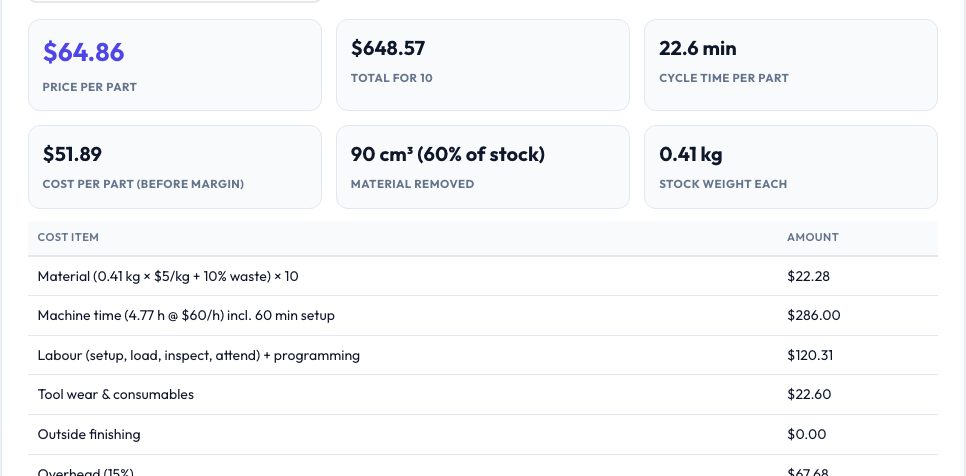
A 100 × 60 × 25 mm 6061 aluminium block machined down to 60 cm³ (finishing area 150 cm²): 90 cm³ removed, 3.6 min roughing + 15 min finishing + 4 min of extra operations = a 22.6 min cycle. With two setups, 1.5 h of programming and standard shop rates the price is about $233 for a single piece, $65 per part at 10 pieces and $48 per part at 100 (−79%).
Who uses this tool
Makers and small shops
Quote jobs consistently.
Engineering students
Understand the cost drivers of subtractive manufacturing.
Startups
Budget for prototype and small-batch machined parts.
Tips for the best results
- Use your real MRR from tooling data rather than defaults.
- Reducing setups (one-op parts) often saves more than faster cutting.
- Quote small batches with the setup included; offer quantity breaks.
- Add a contingency for tight tolerances and surface finishes.
Common mistakes to avoid
- Forgetting setup and programming for single pieces.
- Using one machine rate for all machines.
- Ignoring tool wear on hard materials.
Why use AZRS QuickFix?
It is 100% free, needs no signup and has no watermark or usage limits. The tool runs in your browser, so what you type stays on your device, and it works on phones, tablets and desktops. New tools are added every week — bookmark this page or browse the full QuickFix toolbox.
Frequently asked questions
How accurate is it?
It is a planning model; real quotes depend on toolpaths, fixturing and tolerance.
Where do I get part volume?
From CAD mass properties or the STL viewer.
What MRR should I use?
Defaults are conservative for a small VMC; use your tool maker's cutting data.
Does it include 5-axis?
No — it is a 3-axis milling model; raise machine rate and setups for 5-axis.