Compression Spring Design Calculator
Spring rate, stress, solid height, buckling and number of coils for compression springs · free, no signup
See Compression Spring Design Calculator in action
Free Compression Spring Calculator
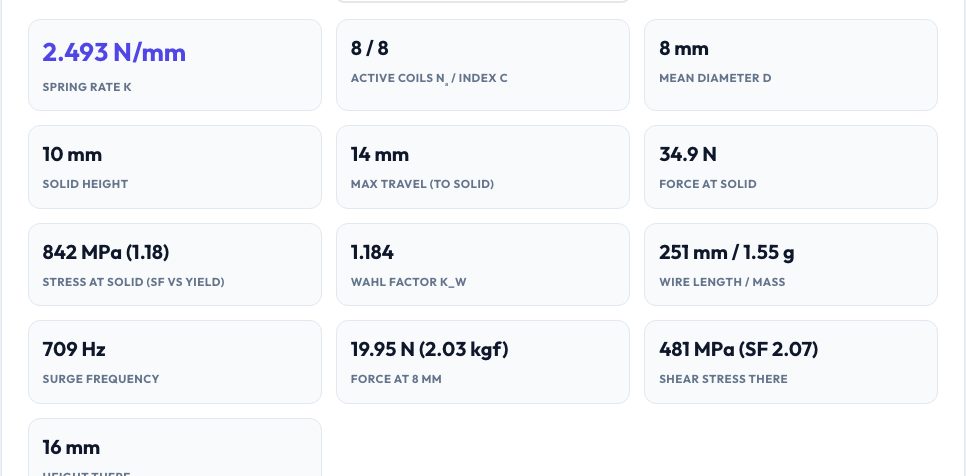
Enter the wire material and diameter, the outside diameter, the total number of coils, the end type and the free length and the calculator returns the spring rate k = G·d⁴ ÷ (8·D³·Nₐ), the spring index, the Wahl-corrected shear stress, the solid height, the maximum travel and force, the stress and safety factor at solid, the force and stress at your working deflection, buckling check using end-fixity factors, the wire length and mass, and the surge frequency.
A design tab solves the reverse problem: give it the target rate, wire and outside diameter and maximum force and it returns the active coils needed, the total coils, the minimum free length and the stress — then you can paste those values into the analyse tab. Materials include music wire, hard-drawn, stainless 302/304, chrome vanadium and phosphor bronze with typical shear moduli and tensile-strength constants.
Key features
Rate & stress
k, Wahl factor, stress at working and solid deflection, safety factor.
Buckling & surge
Shigley buckling criterion and surge frequency.
Design for a rate
Coils needed for a target spring rate and force.
Five wire materials
Music wire, hard-drawn, stainless 302, chrome vanadium, phosphor bronze.
How to use it
- Pick the wire material and enter d, outside diameter, coils and free length.
- Set the working deflection.
- Check the warnings (index, solid stress, buckling).
- Use the design tab to find coils for a target rate.
Worked example
Example
Music wire, d = 1 mm, OD 9 mm, 10 coils closed & ground, free length 24 mm: D = 8 mm, C = 8, Nₐ = 8, k = 2.49 N/mm, solid height 10 mm, 8 mm deflection gives 19.9 N at 481 MPa (safety factor 2.1 against torsional yield).
Who uses this tool
Mechanical design students
Check spring homework and see each formula's effect.
Product designers
Size springs for latches, buttons and hinges.
Makers
Specify a spring when ordering from a supplier.
Tips for the best results
- Keep the spring index between 4 and 12.
- Do not compress to solid in service; limit travel to ~85% of maximum.
- Use music wire for small, high-stress springs and stainless for corrosion resistance.
- Guide long springs (L₀/D > 4) to prevent buckling.
Common mistakes to avoid
- Forgetting that closed ends do not count as active coils.
- Ignoring the Wahl factor at low index.
- Using static stress limits for a spring that cycles millions of times.
Why use AZRS QuickFix?
It is 100% free, needs no signup and has no watermark or usage limits. The tool runs in your browser, so what you type stays on your device, and it works on phones, tablets and desktops. New tools are added every week — bookmark this page or browse the full QuickFix toolbox.
Frequently asked questions
Which stress limit is used?
Torsional yield S_sy ≈ 0.45 S_ut (0.35 for stainless and bronze), with S_ut = A/d^m.
Does it cover fatigue?
No — static analysis only; fatigue needs a Goodman analysis.
What about extension or torsion springs?
Only helical compression springs are covered.
How is buckling checked?
By the critical deflection ratio with end-fixity factors α (0.5–2).