2D Truss Solver — Member Forces, Reactions & Deflections
Solve pin-jointed trusses: tension/compression in every member, support reactions and displacements, with a force diagram · free, no signup
Structure (units: mm, N, MPa)
See 2D Truss Solver — Member Forces, Reactions & Deflections in action
Free 2D Truss Solver & Calculator
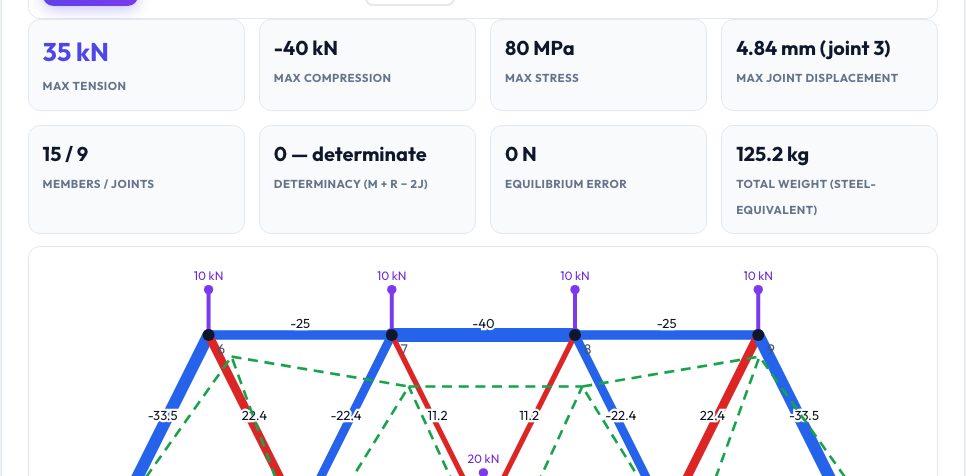
Trusses are the classic statics problem: straight members pinned together at joints and loaded only at the joints, so each member carries a pure tension or compression force. This solver uses the direct stiffness method — the approach used by professional structural software — to find the axial force in every member, the support reactions and the movement of every joint for any 2D truss you type in: list the joint coordinates, the members as joint pairs, the supports (pin or roller) and the loads. Examples such as a Warren, Pratt or Howe girder, a cantilever bracket and a crane jib are one click away.
Results include a colour-coded diagram — red for tension, blue for compression, line thickness proportional to force — with an optional exaggerated deformed shape, plus tables of forces, stresses, elongations, reactions and displacements and a CSV export. Equilibrium is checked, static determinacy (m + r − 2j) is reported, mechanisms are detected, and Euler buckling safety factors are shown for compression members when you give an I value. For the textbook triangle with a 10 kN apex load the bottom chord is +3,333 N (tension) and the sloping members −6,009 N (compression).
Key features
Direct stiffness method
Exact axial forces, reactions and displacements for any 2D pin-jointed truss.
Force diagram
Tension red, compression blue, thickness by force, optional deformed shape.
Checks built in
Equilibrium check, determinacy, mechanism detection, Euler buckling.
Presets and CSV
Warren, Pratt, Howe, bracket and crane examples; download results.
How to use it
- Pick an example or type joints, members, supports and loads.
- Choose material and default member area.
- Press Solve and read the diagram and tables.
- Adjust member areas and re-solve until stresses are acceptable.
Worked example
Example
A triangle with joints at (0,0), (4000,0) and (2000,3000) mm, a pin at joint 1, a roller at joint 2 and a 10 kN downward load at the apex gives reactions of 5 kN each, 3.33 kN tension in the bottom chord and 6.01 kN compression in each sloping member.
Who uses this tool
Engineering students
Check statics homework and understand load paths.
Makers and builders
Size roof trusses, jibs, brackets and 3D-printed frames.
Designers
Compare truss layouts for weight and stiffness.
Tips for the best results
- Number joints from 1 in the order of the node list.
- Apply loads at joints — convert distributed loads to joint loads.
- Use a pin at one support and a roller at the other for a determinate truss.
- Make compression members stockier — buckling often governs.
Common mistakes to avoid
- Leaving a rectangular panel without a diagonal — it is a mechanism.
- Forgetting that members carry axial force only (no bending).
- Mixing units: this tool uses mm, N and MPa.
Why use AZRS QuickFix?
It is 100% free, needs no signup and has no watermark or usage limits. The tool runs in your browser, so what you type stays on your device, and it works on phones, tablets and desktops. New tools are added every week — bookmark this page or browse the full QuickFix toolbox.
Frequently asked questions
Is it only for trusses?
It handles pin-jointed bar structures; frames with bending need a beam-element solver.
How do I know if the truss is stable?
The solver reports an unstable mechanism if it cannot find a unique solution.
What do tension and compression mean?
Tension pulls a member longer (positive); compression pushes it shorter (negative).
Is it free?
Yes, in your browser.