Fillet Weld Size & Strength Calculator (AISC & Eurocode)
Capacity of fillet welds from leg size and length: AISC ASD/LRFD and Eurocode 3, with minimum and maximum size · free, no signup
See Fillet Weld Size & Strength Calculator (AISC & Eurocode) in action
Free Fillet Weld Strength Calculator
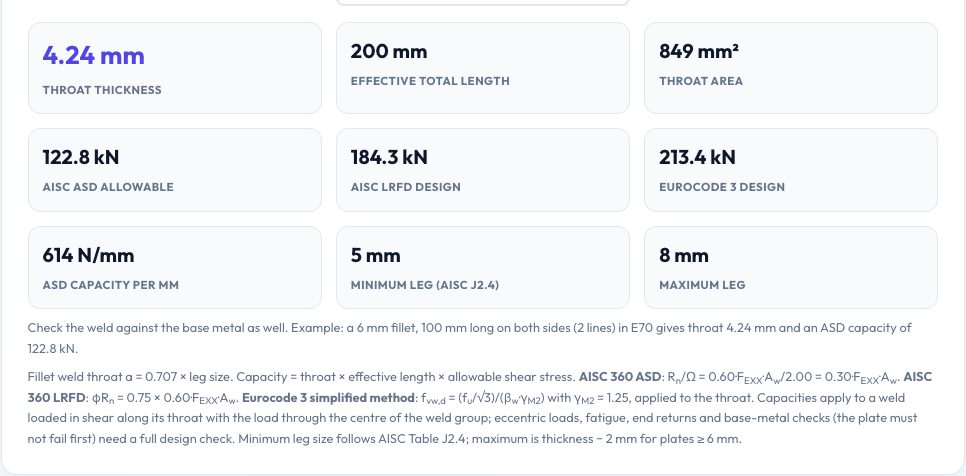
A fillet weld fails along its throat — the shortest distance through the weld from the root to the face, equal to 0.707 times the leg size for an equal-leg weld. This calculator multiplies the throat by the effective length and the allowable shear stress to give the capacity of a weld group: choose the leg size, the length of each weld, how many lines of weld you have (for example both sides of a plate), the electrode strength (E60 to E110) and the base steel, and it returns capacities by three methods — AISC 360 allowable strength design (0.30·F_EXX), AISC 360 LRFD design strength (0.75 × 0.60·F_EXX) and the Eurocode 3 simplified method with the throat and the steel's ultimate strength and correlation factor.
It also reports the capacity per millimetre, the AISC minimum leg size for the thicker plate (Table J2.4) and the maximum leg size, optionally deducts start/stop craters, and shows utilisation and weld shear stress for a load you enter. For a 6 mm fillet weld 100 mm long on both sides in E70 the throat is 4.24 mm and the ASD capacity is 122.8 kN. These are quick design checks for loads through the weld centroid; eccentric loads, fatigue and the base-metal strength still need a full design check.
Key features
Three design methods
AISC ASD, AISC LRFD and Eurocode 3 simplified method.
Size limits
Minimum and maximum leg size per plate thickness.
Load check
Utilisation and shear stress for an applied force.
Electrodes and steels
E60–E110 and S235–S460.
How to use it
- Enter leg size, weld length and the number of lines.
- Choose the electrode and base steel.
- Read the capacities and the size warnings.
- Enter your load to see utilisation.
Worked example
Example
A 6 mm leg fillet, 100 mm long on two sides in E70 electrode metal has a throat of 4.24 mm, a total throat area of 848.5 mm², an ASD allowable load of 122.8 kN and an LRFD design strength of 184.3 kN.
Who uses this tool
Fabricators and welders
Check that a weld is big enough for the load.
Engineering students
Learn weld throat and capacity calculations.
Makers
Size welds for frames, jigs and trailers.
Tips for the best results
- Increase leg size or length rather than relying on very large single passes.
- Remember weld capacity assumes a sound, fully fused weld.
- Check the plate itself — base-metal shear can govern thin sections.
- Use end returns and continuous welds for fatigue-sensitive parts.
Common mistakes to avoid
- Using the leg size instead of the throat.
- Applying capacity to eccentric loads without a moment check.
- Ignoring minimum size rules for thick plates.
Why use AZRS QuickFix?
It is 100% free, needs no signup and has no watermark or usage limits. The tool runs in your browser, so what you type stays on your device, and it works on phones, tablets and desktops. New tools are added every week — bookmark this page or browse the full QuickFix toolbox.
Frequently asked questions
What is the throat of a fillet weld?
0.707 times the leg for an equal-leg 45° fillet.
ASD or LRFD?
They are alternative formats of the same AISC method; use the one your project requires.
Does it check the plate?
No — only the weld metal.
Is it free?
Yes.